


CEPF
Critical Ecosystem Partnership Fund
Regional Implementation Team
Madagascar Indian Ocean Islands Biodiversity Hotspot

The Critical Ecosystem Partnership Fund (CEPF) is a joint initiative of l’Agence Française de Développement (AFD), Conservation International (CI), the European Union (EU), la Fondation Franklinia, la Fondation Hans Wilsdorf, the Global Environment Facility, the Government of Canada, the Government of Japan, the Hempel Foundation, The Nature Conservancy and the World Bank. Its fundamental objective is to ensure that civil society is engaged in biodiversity conservation.
Thanks to funding from the Green Climate Fund (GCF) through AFD as an accredited entity for the GCF, and from the EU through AFD as a fiduciary agent, CEPF has established and manages a 10-year program of US$50 million to support civil society organizations in promoting ecosystem-based adaptation in Madagascar and the Indian Ocean Islands Biodiversity Hotspot.
Under the auspices of the Ministries of Environment in the Comoros, Environment and Sustainable Development in Madagascar, Finance, Economic Planning and Development in Mauritius, and Agriculture, Climate Change and Environment in the Seychelles, the program's activities are being implemented in the Comoros, Madagascar, Mauritius, and the Seychelles.
CEPF WEBSITE : https://www.cepf.net/our-work/biodiversity-hotspots/madagascar-and-indian-ocean-islands
EXPLORE THE INTERACTIVE PROJECT & KBA MAP HERE:
https://www.google.com/maps/d/viewer?mid=1SuEfGxruyUVRqjG8Ts-Bw9gsgUEPfXE&femb=1&ll=-14.615792481273083%2C48.033332000000016&z=4
Regional Implementation team (RIT)
led by IUCN NL
The RIT can be reached via the following email address: cepfproposals@iucn.nl
Training Session
MADAGASCAR (6th to 9th September 2022)

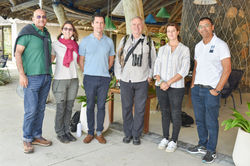
Training of the MADIO Biodiversity Hotspot RIT Team by CEPF.
Led by IUCN NL, the RIT comprises of FORENA (Mauritius), SAF FJKM (Madagascar), Initiative Developpement (Comoros) and SEYCCAT (Seychelles)
LEARN MORE ABOUT MADIO RIT ACTIONS VIA THE DEDICATED WEBSITE:
https://www.iucn.nl/en/project/protecting-biodiversity-on-madagascar-and-the-indian-ocean-islands/

CEPF Grievance Mechanism
MADIO* Biodiversity Hotspot
(*MADIO stands for Madagascar and Indian Ocean Islands. The biodiversity hotspot includes Madagascar, Comoros, Seychelles and Mauritius)
The Critical Ecosystem Partnership Fund (CEPF) abides by a set of procedures regarding Grievances from Grantees, Local Communities, Stakeholders and Regional Implementation Teams (RIT).
For the MADIO Biodiversity Hotspot, the RIT is led by IUCN NL and is constituted of a consortium of organisations for each member country.
Within the RIT consortium, Fondation Ressources et Nature (FORENA) represents the Republic of Mauritius.
GRIEVANCE MECHANISM
“The grantee will share all grievances received, with the CEPF Grant Director and RIT contact person within 15 days. If the claimant is not satisfied following the RIT’s response, the claimant will have the option of submitting their grievance directly to:
- The RIT and IUCN NL’s Complaints Procedure is publicly available on IUCN NLs website. All complaints may be submitted formally in writing to the IUCN NL Complaints Committee at mail@iucn.nl or use the telephone number: +31 (0)20 626 1732.
- CEPF can be reached via the CI Ethics Hotline at www.ci.ethicspoint.com or via phone to a toll-free telephone line: +1-866-294-8674.
Any complaints submitted to the CI Ethics Hotline will be investigated promptly and treated as confidential to the extent possible. CEPF and the RIT will not retaliate against any person or organisation that submit such complaints in good faith.
Any person or group of people affected by the environmental or social aspects of a project funded by the CEPF as part of its program entitled “Ecosystem-based adaptation in the Indian Ocean”, funded by the Green Climate Fund (GCF), through the French Development Agency (AFD) as an accredited entity, who would have exhausted all possibilities of dialogue with the RIT and via the “CI Ethics Hotline” » can use the environmental and social grievance mechanisms of the AFD and the GCF.
For the AFD mechanism, grievances can be sent:
-
by filling out the form online on the AFD website (www.afd.fr)
-
by sending an email to: reclamation@afd.fr
-
by mail to the attention of:
French Development Agency
Secretariat of the Environmental and Social Complaints Management System
5, Rue Roland Barthes
75598 Paris Cedex 12
France
For the GCF mechanism, grievances can be sent:
-
by completing the online form on the GCF website (https://irm.greenclimate.fund/)
-
by sending an email to: irm@gcfund.org
-
By telephone: +82.32.458.6585
-
By mail to the attention of:
Independent Redress Mechanism
Green Climate Fund
Songdo Business District
175 Art Center-daero
Yeonsu-gu, Incheon 22004
Republic of Korea
 |  |  |  |
|---|---|---|---|
 |  |  |  |
 |  |  |  |
 |  |  |  |
 |  |  |  |
 |  |
Funding Cycle 2022-2027
Glimpses of Grantee Site Visits, Supervision Mission and Interaction with Donor Organisations
EXPLORE THE ECOSYSTEM PROFILE
OF THE MADIO BIODIVERSITY HOTSPOT

THE ECOSYSTEM PROFILE
The MADIO Hotspot includes the Comoros, Madagascar, Mauritius (including the island of Rodrigues) and the Seychelles. The land area of the hotspot is about 600,000 km2 , of which 592,040 km2 consists of the island of Madagascar alone. The evolution of a diversity of fauna and flora with a very high rate of endemism at the level of species, genera, and even families, on Madagascar is striking. The terrestrial biodiversity of the other archipelagos is closely linked to that of Madagascar. Despite covering a much smaller land area, the other island groups of the western Indian Ocean contribute much to the biological diversity of the hotspot with high rates of endemism. African influences are especially marked in the biota of the Comoros, while Asian ones are especially evident in the Seychelles. Although the hotspot is defined in terms of its importance for terrestrial biodiversity, its marine biodiversity is also exceptional, both in terms of levels of endemism (corals, coastal species and marine trenches) and in terms of the international importance of populations of certain widely distributed species, such as cetaceans and marine turtles.
In terms of extent of original natural vegetation, MADIO ranks tenth among the 36 biodiversity hotspots globally. and eighth in terms of remaining intact habitat, according to recent estimates of forest cover. The MADIO Hotspot covers a set of extremely varied habitats, resulting from climatic variability linked to latitude, altitude and steep relief, which due to foehn effects linked to trade winds, concentrates precipitation on the eastern slopes of the massifs. The geological viii and pedological differences (granitic base, ancient or recent volcanism, atolls and sandy formations, sedimentary formations) add to the diversity of habitats.
USEFUL LINKS FOR GRANT APPLICATIONS:
Frequently asked questions:
-
English: Sample letter of inquiry and Sample budget / Online form
-
French : Sample letter of inquiry et Sample budget / Online form